
Ball State University Sued by ACLU of Indiana Over 50-Foot Protest Ban and Disciplinary Action for Student Speech

MUNCIE, Ind. (The CI) - The American Civil Liberties Union (ACLU) of Indiana has sued Ball State University in two federal lawsuits over the University’s Non-Commercial Expressive Activity and Assembly on University Property policy.
The suits, one representing Cooper Archer, who was suspended from the University, and another representing 10 students, were filed today, March 2, 2026.
Table of Contents
What is the Non-Commercial Expressive Activity and Assembly on University Property Policy?
The policy, first adopted in 2022 and updated in July 2025, outlines the rules for how, when, and where people can gather on campus.
According to the policy, it “outlines the University’s regulations regarding Non-Commercial expressive activity and assembly on the University’s Campus or in University Facilities. It sets forth reasonable time, place, and manner regulations that apply to all students, employees, visitors, and other individuals while on Campus.”
However, the suits claim this policy restricts free speech.
Section 3.4 of the policy and its subsections bans “assemblies, protests, or other demonstrations” within 50 feet of University buildings.
“Assemblers, protesters, or demonstrators who refuse to vacate any of the locations listed in this subsection upon request may be subject to suspension and/or arrest under applicable laws,” the policy reads.
Both suits claim that “[v]irtually every building on the Campus” falls under Section 3.4 and its subsections, and “even buildings used primarily for athletic or entertainment purposes generally ‘hav[e] an administrative office’ such that they fall within section 3.4.5 of the policy.”
The suits “also contest the university’s use of campus rules to punish students who entered the administration building during normal business hours to leave notes for President Geoffrey S. Mearns expressing concerns about the university’s financial ties to Israel,” according to the ACLU of Indiana’s press release.
What do the suits allege happened?
DISCLAIMER: Everything in this section is sourced from one or both lawsuits filed with the ACLU of Indiana. “The joint suit” refers to the suit filed by 10 plaintiffs. “Archer’s suit” refers to the suit filed with Cooper Archer as the sole plaintiff. “The suits” refer to both of these lawsuits.
The Demonstration
The suits allege that, on November 19, 2025, “[a]pproximately twelve or fifteen persons” demonstrated at the Scramble Light at 4:00pm, “about a dozen” from the group walking to the Admin Building at 4:30pm “for the sole purpose of leaving notes for President Mearns expressing their opposition to Ball State’s refusal to sever its financial ties to Israel.” The plaintiffs “noticed that persons within the building, apparently having seen their approach, appeared to be attempting to lock the external doors of the building to prevent them from entering.”
The joint suit states that one student, Alex Bordenkecher, found an unlocked door and everyone entered the building.
The suits allege that students stopped chanting when they entered the Admin Building, and that around 4:40pm, when they arrived at President Mearns’ office, it was locked, and no staff were visible through the windows on the door.
A couple minutes later, the suits claim Vice President of Student Affairs Ro-Anne Royer Engle and Assistant Vice President for Student Affairs Tiffany Peters approached.
Allegedly, Royer Engle told the students to leave. When a student allegedly asked to identify the policy, Royer Engle “simply repeated her request that the students exit the building,” according to the suits.
The suits state, “[a]fter some back-and-forth,” Royer Engle stated, “I’ll get a piece of paper [and] you can leave a message,” and “I’m gonna get you a piece of paper, each of you can leave a message for the president.” After paper was provided and some plaintiffs turned in their letters, “Ms. Royer Engle explained to the students that their activity was prohibited by the 50-foot Policy, and she displayed this policy to some of the students on her cell phone.”
Junior Velez arrived a couple minutes before 5:00pm due to work, and, according to the joint suit, was “entirely unaware” that Royer Engle told students to leave.
When Royer Engle allegedly told students to leave the building at 5:00pm, the suits claim they did.
The Charges
Archer’s suit states, prior to the demonstration, he was on conduct probation. The joint suit states they’ve received a letter from Director of the Office of Student Conduct Kaleigh Richardson “that an allegation had been made that their activity on November 19th violated several university policies.” Archer’s suit states he was informed by Richardson on December 1, 2025 over email.
The students, according to the suits, were invited to a preliminary meeting, where they, including Velez, were allegedly charged with violating the Expressive Activity Policy, the Disorderly Conduct Provision (Section 4.2.4 of the Student Code of Rights and Responsibilities), and Failure to Comply (Section 4.2.5 of the Code).
The Hearing
All students reportedly attended individual, according to the suits, which claimed Richardson served as the “complaintaint” on behalf of the University.
The joint suit claims Associate Vice President for Student Affairs, Dean of Students and Title IX Coordinator T.J. Brecciaroli served as the hearing officer for the 10 plaintiffs. One plaintiff was unable to attend due to studying abroad.
Archer’s suit doesn’t mention a hearing officer by name, but does mention he was heard by a “University Review Board,” rather than a hearing officer. Archer’s suit refers to the board as “an entity comprised of select students, faculty, and staff of Ball State that is responsible for, inter alia, hearing certain disciplinary matters[.]”
The suits state everyone was allowed to have an “advisor,” though the advisor is “not permitted to directly participate in the hearing[,]” and that questions were required to be submitted on paper and be approved by Brecciaroli (or, according to Archer’s suit, “the ‘Hearing Board Chairperson’”) for “the appropriateness of each question.”
Brecciaroli upheld all charges for 9 of the plaintiffs in the joint suit. According to the joint suit, Velez wasn’t charged with Failure to Comply.
The Board upheld all charges for Archer.
Everyone, except for Velez, on the joint suit allegedly…
Was placed on conduct probation, either for this Spring semester or for a year,
Was required to complete ten hours of community service, and
Was required to write “a 1,500-word ‘research and reflection paper’ following certain guidelines.”
According to the joint suit, Velez…
Was required ten hours of community service,
Was “issued an ‘official warning’ that their behavior was ‘unacceptable,’” and
Was required to write “a 1,500-word ‘research and reflection paper’ following certain guidelines.”
Richardson allegedly sent a letter to Archer on December 18, 2025, suspending him until May 8, 2026, requiring him to meet with the Director or a designee of the Office of Student Conduct and that he would be on conduct probation for a year. The next day, according to Archer’s suit, a letter was received that he couldn’t “be on University premises[,] register for classes, or to attend any University-sponsored event or activity at any time, for any reason, without specific, prior written permission from the Office of Student Conduct[,]” under “threat of being arrested for trespassing[.]”
The Appeal
The suits claim everyone except Cheyanne Watkins appealed the decision.
The joint suit states Watkins didn’t appeal, as they were studying abroad and “Mr. Brecciaroli’s decision—and the sanctions imposed by that decision—became final.”
In February 2026, everyone in the joint suit, except Watkins, received a decision on their appeals from Director of Employee Relations Melissa Rubrecht. Rubrecht allegedly removed the Disorderly Conduct charge from their records, concluding “that the sanctions for these violations was ‘sufficient to address [the appealing plaintiffs’] conduct on November 19, 2025[.]”
Community service was dropped for all plaintiffs in the joint suit.
Archer’s suit states Vice President for People and Culture Mark Liebling reviewed his appeal, which was initially denied in a letter on January 5, 2026. The suit further states Archer received a second letter from Liebling “even though no intervening events took place related to [his] appeal.” Liebling’s second letter, similarly, dropped the Disorderly Conduct charge from Archer’s record.
Archer’s suit asserts the sanctions against him weren’t modified.
The Factual Allegations and Legal Claims in The Suits
Archer’s suit claims he lost his job on campus.
The suits claim all plaintiffs are “suffering irreparable harm for which there is no adequate remedy at law.”
The joint suit claims Mearns in his official capacity, as well as Richardson, Brecciaroli and Rubrecht in their University and individual capacities (the defendants of that suit) “have acted or refused to act under the color of state law.”
Archer’s suit claims Mearns in his official capacity, as well as Richardson and Libeling in their University and individual capacities (the defendants of that suit) “have acted or refused to act under the color of state law.”
The suits claim the 50-foot policy in the Expressive Activity Policy and its enforcement “violates the First Amendment to the United States Constitution.”
The suits claim the Failure to Comply provision of the Code and its enforcement “violates the First and Fourteenth Amendments to the United States Constitution.”
The suits claim “The discipline against the plaintiff for engaging in expressive activity that was not disruptive to university operations violates the First Amendment to the United States Constitution.”
The Request to the Court
The suits request the court to…
Accept jurisdiction,
Declare the defendants in each suit have “violated the rights of the plaintiff[(s)],”
Issue a permanent injunction prohibiting the defendants to enforce the Failure to Comply policy,
Issue a permanent injunction to require the defendants to “completely expunge any records relating to the discipline issued to the plaintiff[(s)'],”
Award damages,
Award attorney’s fees, and
Award “all other proper relief.”
Archer’s suit requests a permanent injunction prohibiting the defendants to enforce the 50 feet policy, while the joint suit requests “a preliminary injunction, later to be made permanent” for that.
What did Bordenkecher say about what happened?
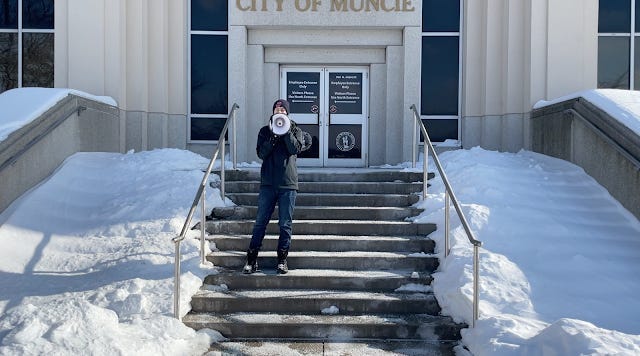
Prior to the ACLU of Indiana’s lawsuits, The CI heard a speech from Bordenkecher at a protestagainst Immigration and Customs Enforcement (ICE) outside Muncie City Hall.
“Two months ago, at this point, 12 students went into Ball State to leave a letter with President Mearns, wondering why our tuition is funding genocide, and why he has promised to comply with ICE when they inevitably come on to Ball State’s campus,” Bordenkecher said in a speech. “[ICE has] already been in Muncie several times in January alone. Last year, I’ve known they’ve taken people. They’ve taken people since then.”
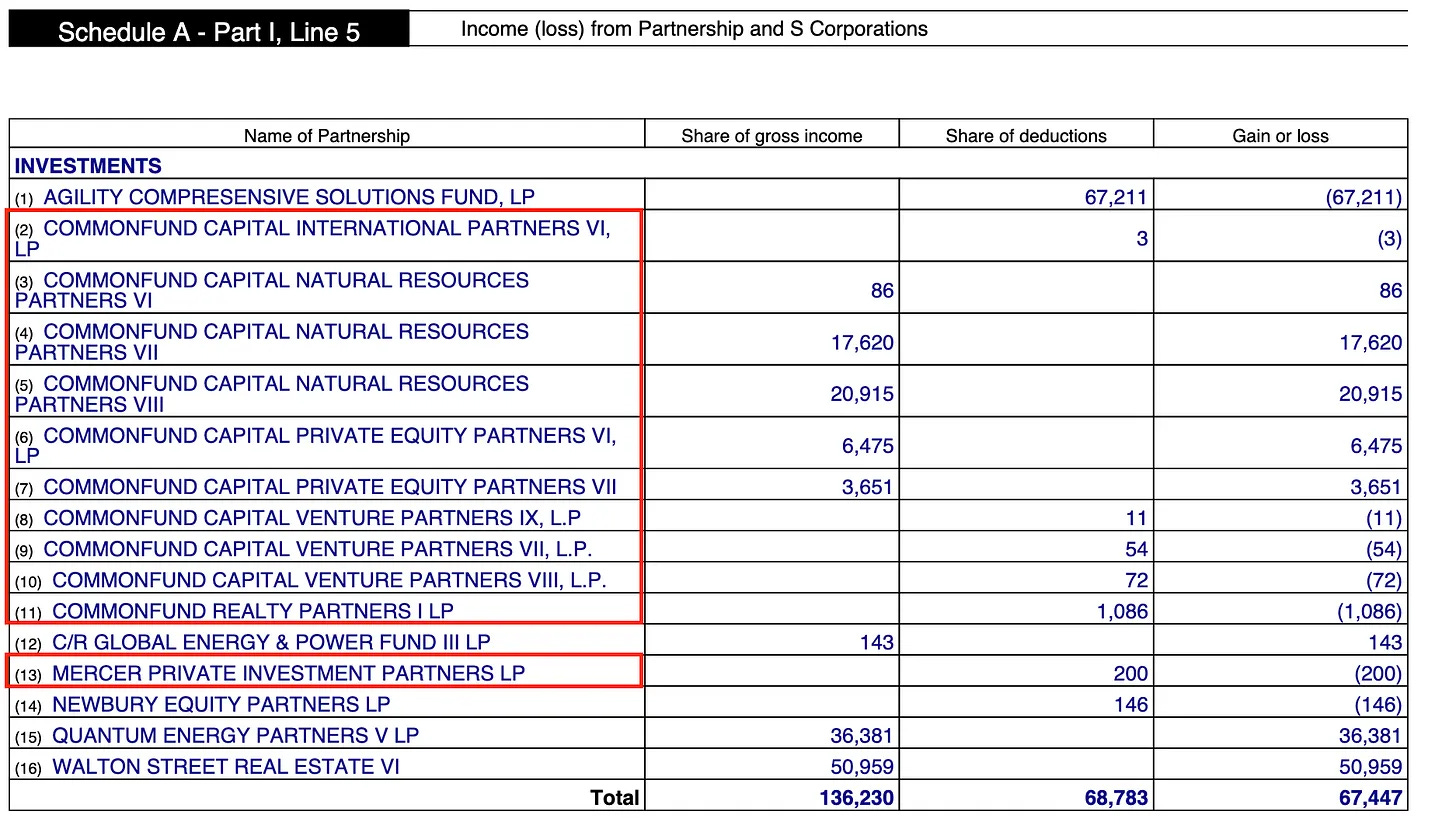
SJP Muncie has posted that the University is invested with CommonFund, Mercer and Carlyle Group through the Ball State University Foundation, and utilizes Cisco software, such as two-factor authentication app Duo Mobile.
The CI has verified that, according to an IRS Form 990 (page 61) from July 1, 2023 to June 30, 2024, the Ball State University Foundation has invested in Mercer Ventures and Commonfund.
“We were there during business hours, we were being nice and polite, it was literally 12 people standing in a lobby, we weren’t blocking any doors or anything,” Bordenkecher asserted. “They tried to get us to leave, but we declined. They finally let us leave our letters, and we left at 5 o’clock. The next week, we all found that we were charged with several conduct policy violations. And, since then two months later, last week, we were all found guilty, obviously, and Cooper, who spoke before me, was suspended.”
Bordenkecher sent an Op-Ed, titled “Ball State’s Latest Repression” to The CI in December 2025.
In the Op-Ed, Bordenkecher noted it was the fourteenth day of the Sumud Hunger Strike, and that Ball State “still refused to even directly acknowledge SJP [(Students for Justice in Palestine)].”
According to a speech given by Brianna Ramon, the strike called for “a complete divestment from these companies that have ties to Israel that Ball State's investing in,” that “the Board of Trustees meet with the Students for Justice in Palestine board,” that “free speech is no longer inhibited on campus,” and that “Brian Gallagher and Michael Conner sever their ties with Ball State and are fired promptly.”
For context, the Op-Ed is provided below in-part, with the full Op-Ed linked below.
“So, students returned to the Admin Building— once again trying to leave letters for their president. The administration once again violated the students’ rights and attempted to lock them out of the entire Admin Building. They weren’t quick enough however, and the students entered despite the Administration's best efforts. Once again, the students found all the offices inside, including the Office of the President, locked up tight.”
Engle returned, along with Tiffany Peters, Assistant Vice President for Student Affairs, who again told the students to leave. The students declined. Like the week prior, they asked the administrators to cite what policy they were supposedly violating by entering a public building, which they pay for, during business hours. Engle claimed they were disrupting business, but there couldn’t have been much business happening since every office was shut down as the students entered. Keep in mind, students leaving a letter with a secretary is routine business at an administration office.
Defeated, Engle conceded and passed out paper so the students could write their letters. As they did, one student, on his third day of the hunger strike, became so dizzy he was unable to stand and collapsed in the lobby of the Admin Building. The administrators did nothing as other students got him food and water. Several minutes later, after the student already had others looking after him, Engle finally asked if he wanted them to call EMS, which he declined. At 5 o’clock, the Admin Building began to close and students were told to exit, and they complied. The next day, the same student was struck by another bout of dizziness and weakness and had to be taken to Ball Memorial Hospital.”
Outside Muncie City Hall, Bordenkecher said “I was given a year of conduct probation for standing in a lobby,” and “There is no First Amendment at Ball State.”
What has Ball State University said about what happened?
Following receipt of the Op-Ed, The CI filed an APRA request with the University for security camera footage, an incident report, redacted conduct reports, and official communications at the time of the incident.
The Office of General Counsel (OGC) stated the University “does not maintain security footage” for the Admin Building lobby and outside Mearns’ office. Redacted conduct reports were denied under Indiana Code 5-14-3-4(a)(3) and the Federal Family Educational Rights and Privacy Act (FERPA). Official communications were denied for being “[n]on-specific, vague, and/or overly broad.”
OGC sent a redacted incident report to The CI.
According to the report, Engle, Vice President for Student Affairs, received a notice from John Foster, Assistant Vice President for Public Safety and Chief of Police, at approximately 4:35 pm. Engle informed Tiffany Peters, Assistant Vice President, of something.
Engle and Peters went downstairs from the second floor together, both observing something. Engle informed the group they were “disrupting University business,” citing the “time, place, and manner” section of the Noncommercial Expressive Activities Policy.
The report claims “[a]n individual trying to access the President’s office for business would not have been able to walk through the lobby to the office[,]” a 9-year-old son of a staff member was escorted by Peters out of the building, and an employee had difficulty locking the south doors at 5:00 pm.
While the report claims something happened around 4:51 pm, it was redacted in its entirety. That redaction, which OGC justified under IC 5-14-3-4(a)(3) and FERPA, is about the length of a page.
You're on the legacy site! This article was originally posted to our Substack. To get articles faster, subscribe or use the new site.